PPC management · Google Ads, Meta & SEO

PPC management that audits before it spends.

I run Google Ads and Meta for growing businesses, with SEO read alongside them, because paid and organic search fight over the same searches. Every engagement starts by reading the account and the website together, then moves fast: waste out within two weeks, tracking rebuilt around real leads, and you approve every change that touches your budget.

What is PPC management with SEO built in?

It's paid search and paid social run as one system with your website, not as a separate channel. Done well, it does five things:

  • Manages Google Ads and Meta campaigns: structure, budgets, bidding, keywords, audiences and ad copy
  • Reads the website the ads send people to, and fixes what's leaking between them
  • Counts real leads, so the bidding algorithm learns from booked jobs instead of noise
  • Shifts searches your site can win organically off the ad budget
  • Reports what was tested, what was learned and what moves next
What's included

What I run, what you build, what you get.

01 / I run

Paid media

  • Google Ads and Meta Ads, end to end
  • Budgets, bidding and campaign structure
  • Keywords, negatives and audiences
  • Search ad copy and offer testing
  • Conversion tracking review and sign-off
02 / Your team builds

From my briefs

  • Landing page changes, from prioritized briefs
  • Creative: video, photo and design
  • Conversion goals and call tracking setup
  • Site edits that SEO recommendations call for
03 / You get

A system

  • A live tracker that reads your accounts on every open
  • Paid and organic mapped together
  • A plain-language change log
  • Monthly reporting: tested, learned, next
  • One person accountable for the number
How onboarding runs

Five stages. One system.

Every FRDTLAB engagement runs on the same operating model: Sense, Structure, Build, Measure, Compound. Here's what each stage means for your ad accounts. Timing is typical; how fast access comes through moves it most.

  1. SenseDays 1 to 4 · read-only

    Access comes in and nothing gets touched. I pull the change history, search terms, conversions and budgets, crawl the website the ads point to, and run market and competitor research with clear evidence rules: what you told me stays separate from what the data shows.

    You get a research brief and the questions that shape everything after.

  2. StructureDays 2 to 5

    A full account audit, a data hygiene check, and a tracking and audience audit. Alongside it, a paid-versus-site SEO review: ad pages competing with your own pages in search, missing local markup, service areas stated different ways, offers in the ads that appear on no page.

    You get the audit and a scope of work.

    Your approval: scope

  3. BuildDays 5 to 10

    Waste comes out first: negative keywords for searches you'd never want, duplicate campaigns, locations you don't serve. Each change goes in as one batch, reviewable and reversible, then gets verified against the platform and logged. Site fixes go to your team the same week as page briefs.

    You get a plain-language change log and prioritized page briefs.

    Your approval: any budget or bid change

  4. MeasureWeeks 2 to 3

    Conversion goals get rebuilt around booked, real leads, and calls and forms get tied back to the channel that drove them. Bidding changes wait until this is signed off. Smart bidding learns from whatever you count, so the signal comes first.

    You get a tracking setup you can trust, reviewed before it goes live.

  5. CompoundWeek 3 onward

    Ongoing management on a test-and-learn cadence: a batch of changes, about seven days, then a read of what the data actually says. A live tracker flags any budget above what you approved. Paid and organic get planned together, so new pages take pressure off the ad budget.

    You get the tracker, a six-week growth plan and a standing monthly report.

Every change, same rules

Nothing moves without a receipt.

Read first

No change goes in until the history explains why the account looks the way it does.

You hold the budget

Budget and bid changes come to you as options, a recommendation and the cost of waiting.

Small and reversible

Changes go in as one batch you can review and roll back.

Verified, then logged

Every change is checked against the platform itself, not a tool's success message.

From a recent onboarding · client anonymized

One gap. Two views. One move closes both.

Seven gaps from a new client's first two weeks. Each one showed up in the ad account and on the website. Fix it in one channel and the other keeps leaking.

The ad promise isn't on the page

What paid sees
Search ads promise an offer no landing page shows.
What organic sees
Same pages, same missing terms. Mixed claims weaken trust signals.
The move
One offer, published on every page the ads send people to.

Ad pages compete with organic pages

What paid sees
A dozen ad pages, 95 to 99% identical copy, all live for ads.
What organic sees
All indexed, none in the top organic pages. Near-copies split relevance with the page built to rank.
The move
Check which ad pages earn searches. Keep the winners, consolidate the copies.

Paying for the brand twice

What paid sees
Performance Max buys brand searches the brand campaign covers for less.
What organic sees
Brand ad clicks falling. Maps or the organic listing may be catching them.
The move
Exclude brand from Performance Max. Read brand across ads, organic and Maps together.

DIY researchers

What paid sees
DIY and idea searches: three days of spend, zero leads.
What organic sees
How-to posts are the top organic pages. Visits, zero leads.
The move
Let organic own DIY for free. Add a “want it built?” path and remarket to readers.

City demand, no city page

What paid sees
The second-biggest city in paid search has the highest cost per conversion.
What organic sees
One city page on the whole site, and it's the best converter.
The move
Use the winning city page as the template. Highest-cost city first.

Local signals Google can read

What paid sees
The ads' map and the site's service area don't match.
What organic sees
Zero pages with local business markup. Service area stated three ways.
The move
One service-area statement that matches the ads. Local markup sitewide.

Measurement can't see the overlap

What paid sees
Calls arrive in analytics with no channel attached.
What organic sees
Search Console isn't linked to Google Ads. No overlap report.
The move
Link Search Console to Ads. Send calls to analytics with their session.
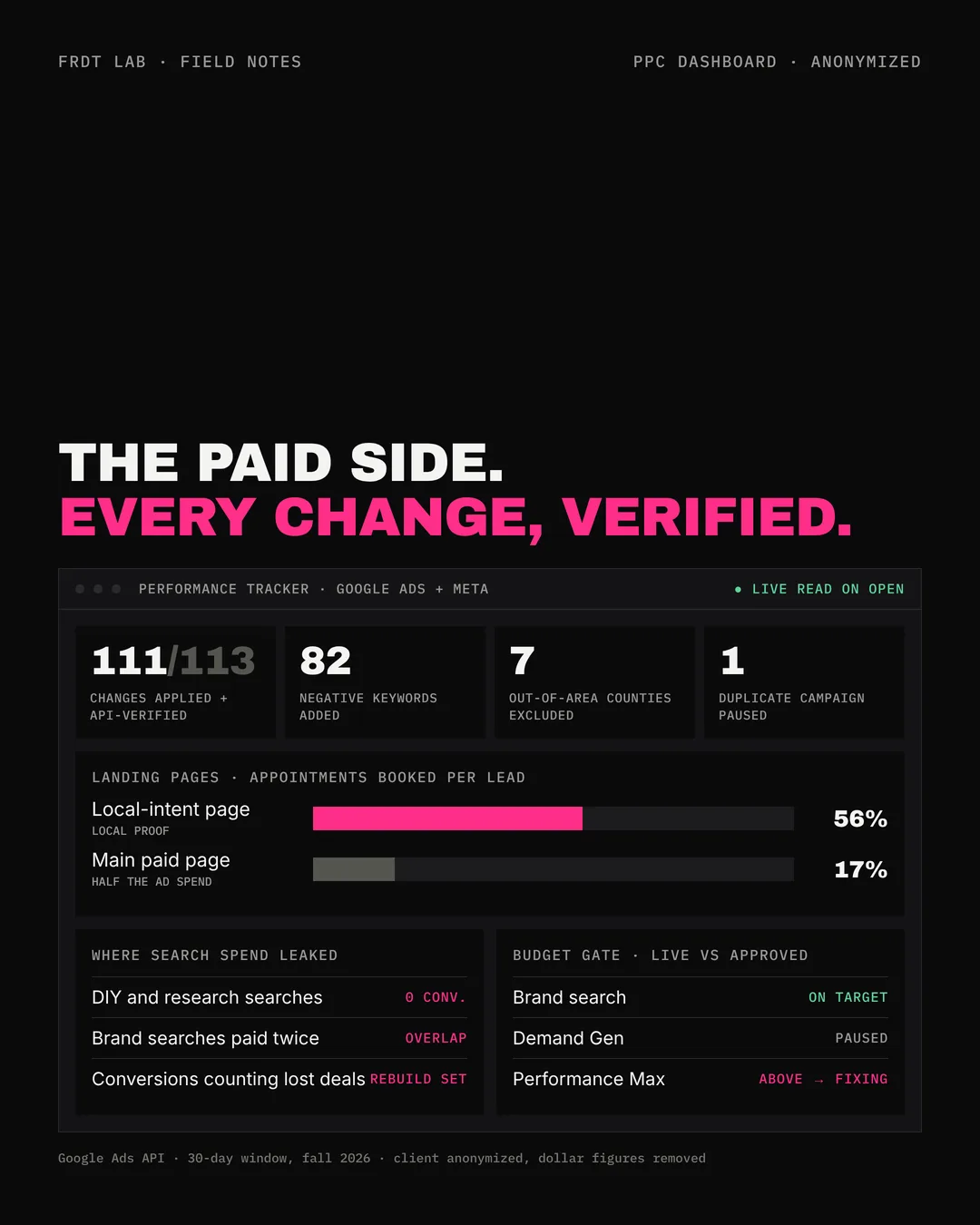
Example PPC performance dashboard: 111 of 113 changes applied and verified, 82 negative keywords added, 7 out-of-area counties excluded, 1 duplicate campaign paused. A local-intent landing page books 56% of its leads into appointments against 17% on the main paid page.
The paid view: every change verified against the platform, and the landing pages that actually book appointments.
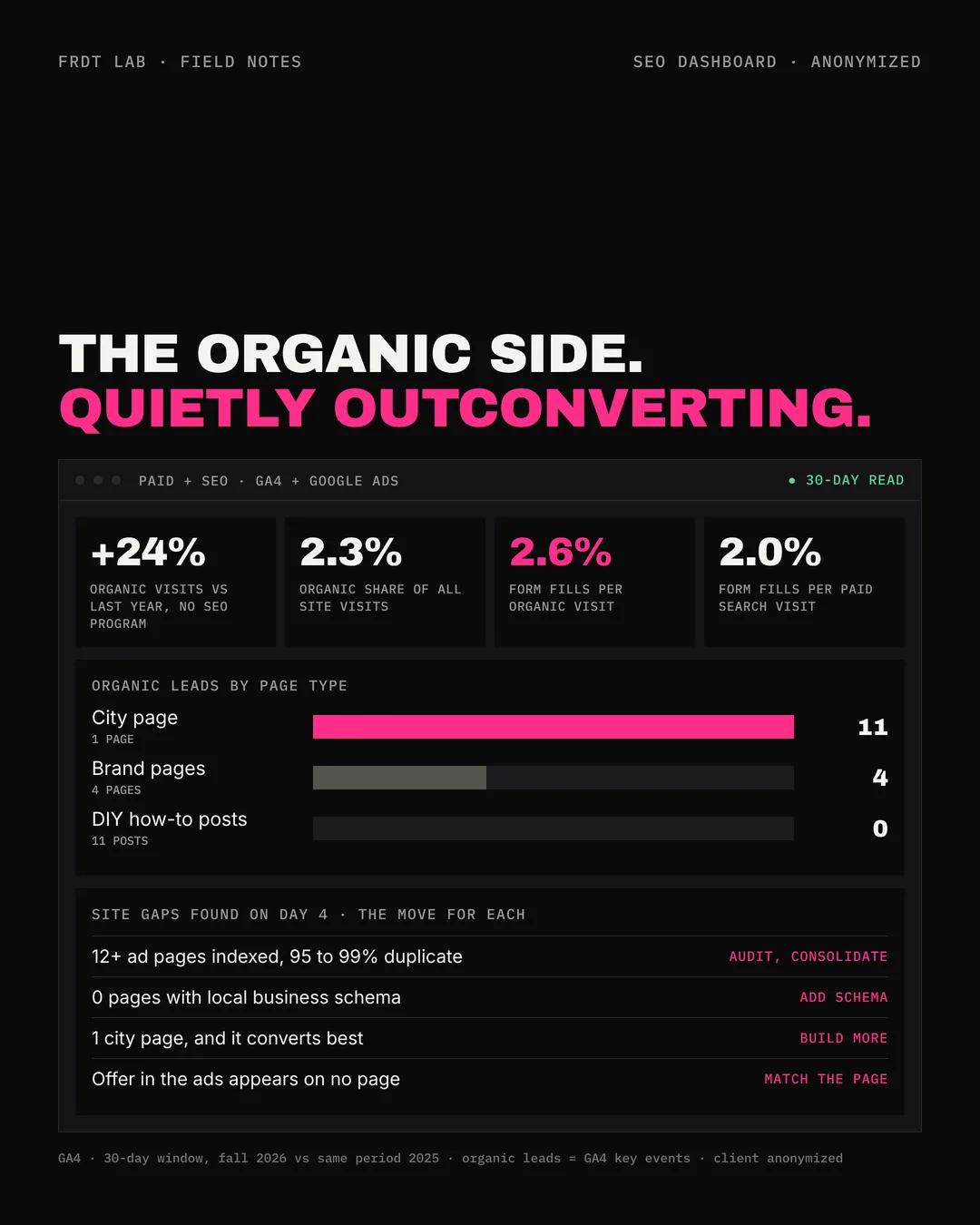
Example SEO dashboard: organic visits up 24% year over year with no SEO program; organic visits convert to form fills at 2.6% against 2.0% for paid search. One city page produced 11 organic leads, brand pages 4, and eleven DIY how-to posts produced none.
The organic view: a small channel quietly outconverting paid, with one city page doing most of the work.
Who it's for

Good fit.

Local and regional service businesses where calls and form fills are the sale, and every wasted click is real money.

Teams taking an account back from an agency or a freelancer, or out of autopilot, who want to see what's actually happening inside it.

Owners who want a second read. Is my agency doing this right? I'll tell you straight, without trashing anybody. It connects to how I build a marketing operating system across every channel, and if search visibility in AI answers is the bigger question, start with the AI Visibility Audit.

FAQ

PPC management, answered.

What's included in PPC management?

Google Ads and Meta Ads run end to end: structure, budgets, bidding, keywords, negatives, audiences, ad copy and conversion tracking review. SEO is read alongside, so paid and organic search are planned together. Landing pages and creative are built by your team or vendor from my briefs.

How long does onboarding take?

The first few days are reading and auditing, across the ad account and the website. Waste removal typically lands within the first two weeks, and a live performance tracker within about three. After that, management runs on a test-and-learn cadence.

How fast do you start making changes?

As soon as the audit explains the account, usually within the first two weeks. First changes are waste removal inside the scope you approved, such as negative keywords, duplicate campaigns and locations you don't serve. Every change is batched, reversible, verified against the platform and logged. Anything that moves budget or bids waits for your yes.

Do you handle SEO as part of PPC management?

Yes. The website gets audited alongside the ad account, because paid and organic search compete for the same searches. The audit flags ad pages competing with your own pages, missing local markup and city pages, and searches you pay for that organic could win. Site changes go to your team as prioritized briefs.

Which platforms do you manage?

Google Ads and Meta Ads, read alongside Google Analytics 4, Google Tag Manager, Search Console, your Business Profile and your CRM, so paid results can be tied to real leads.

Why rebuild conversion tracking before changing bids?

Smart bidding learns from whatever you count as a conversion. If lost deals, duplicate calls or no-show leads are counted, the algorithm gets very good at finding more of them. Bidding changes wait until the conversion setup is signed off.

Can you audit what my agency is doing?

Yes. Sometimes the right first step is a second read: is the account set up well, is the money going where it should, is tracking telling the truth. You get a straight answer and the fixes ranked by impact, without trashing anybody.

How is PPC management priced?

Scoped to your platforms, spend and how much tracking needs rebuilding. Reach out with what you're running and I'll come back with a scope.
Let’s build

What I’m doing in-house, I’m helping other companies do.

Tell me what your ads are spending, what they’re producing, and what you suspect is leaking.

Talk about your account

hello@frdtlab.com · Detroit, MI